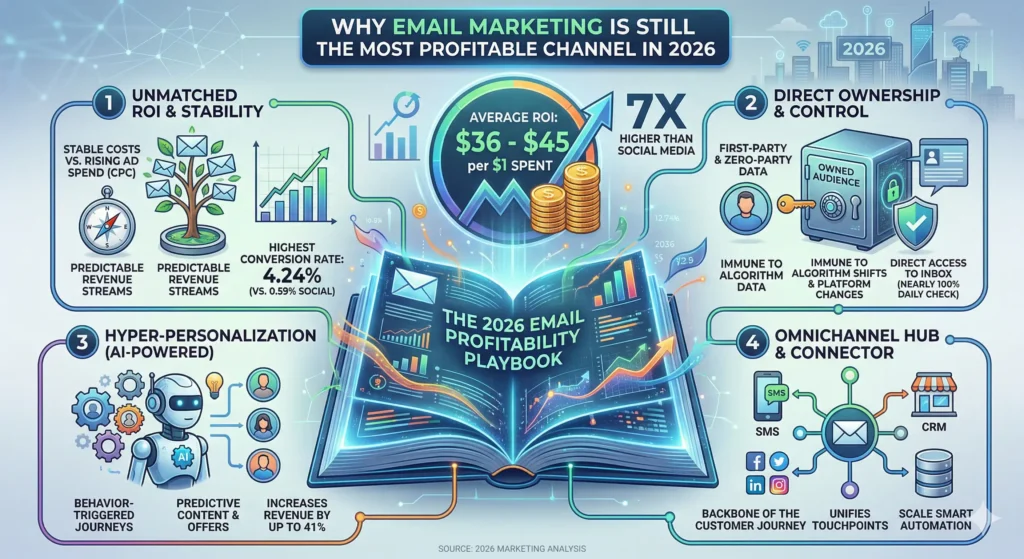
In an era defined by volatile social algorithms and the meteoric rise of generative AI, one might expect the humble email to have faded into obsolescence. However, quite the opposite has occurred. As we navigate the complex digital landscape of 2026, email marketing has solidified its position not merely as a surviving channel, but as the central nervous system of any high-yield digital strategy.best digital marketing agencies While other platforms struggle with fluctuating organic reach and rising acquisition costs, email remains the most resilient and profitable medium available to modern businesses.
The Sovereignty of the Inbox: Owning Your Audience in a Platform-Dependent World
The most significant shift in the 2026 marketing ecosystem is the realization that “rented” audiences on social media are inherently unstable. A sudden algorithm update or a change in platform leadership can instantly sever a brand’s connection with its followers. In contrast, email marketing offers platform independence, providing a stable foundation that remains immune to the volatility of external tech giants. This ownership allows businesses to cultivate long-term relationships without paying a “reach tax” to speak to their own customers.
Furthermore, the data collected through email interactions serves as a fortress of first-party intelligence. When a subscriber engages with your newsletter, they provide behavioral signals that belong exclusively to your organization. By leveraging this data, you can build deep profiles that inform not only your email strategy but your entire product development and sales approach. In a world where third-party data has become scarce and unreliable, the “owned” audience of an email list is the most valuable currency a marketer can possess.
The AI Revolution: Transforming Static Lists into Predictive Relationship Engines
Artificial intelligence has fundamentally reimagined what is possible within the inbox, moving far beyond basic automation into the realm of “predictive empathy.” In 2026, sophisticated email systems no longer wait for a user to take an action; they anticipate the user’s needs based on massive datasets. By integrating AI-driven predictive analytics, brands can now deliver the right message at the exact moment of highest receptivity, ensuring that every touchpoint feels instinctive rather than intrusive.
Moreover, generative AI has eliminated the burden of manual content production while simultaneously increasing relevance. Modern platforms use dynamic content blocks that adapt in real-time to the recipient’s current context—be it their location, recent browsing history, or even their predicted emotional state. This transition from “batch and blast” to hyper-personalized, one-to-one communication has resulted in a 40% increase in revenue for AI-powered campaigns compared to traditional methods.
The ROI Heavyweight: Analyzing the Math Behind the 4,200% Return
The financial argument for email marketing in 2026 remains undisputed. While the cost of customer acquisition through paid social channels has spiked by over 30% in recent years, the operational costs of email remain remarkably stable. Because the infrastructure is scalable and the audience is pre-qualified, the efficiency of this channel is unmatched. Every dollar spent on email goes directly toward nurturing an existing lead rather than gambling on the attention of a cold stranger.
Additionally, email boasts conversion rates that are consistently 7x higher than those of social media platforms. This disparity exists because an email inbox is a destination for intent. When a user opens an email, they are in a “processing” mindset, whereas social media consumption is often passive or entertainment-driven. By meeting customers in a focused environment, brands can drive high-value actions—such as purchases, webinar sign-ups, or consultations—with far greater precision and lower friction.
The Omnichannel Anchor: Centralizing the Modern Customer Journey
In 2026, the customer journey is rarely linear, often spanning across VR showrooms, social discovery engines, and physical retail spaces. Email serves as the essential “connective tissue” that unifies these disparate touchpoints. By acting as the central hub for zero-party data—information that customers intentionally share—email allows brands to maintain a consistent narrative across every channel the consumer visits.
Furthermore, email marketing facilitates the seamless transition from discovery to retention. When a lead is captured via a social media contest or a website interactive tool, the email sequence takes over the heavy lifting of lead qualification and nurturing. This synergy ensures that no prospect falls through the cracks, effectively lengthening the customer lifetime value (CLV) by maintaining a persistent, value-driven presence in the customer’s life long after the initial transaction.
The Trust Dividend: Navigating Privacy with Permission-Based Marketing
As global privacy regulations like the GDPR and updated state-level mandates in the US become more stringent, the “opt-in” nature of email marketing provides a significant legal and ethical advantage. Email is inherently a permission-based medium; the recipient has explicitly invited the brand into their digital home. This foundation of consent builds a level of trust that “interruption marketing” can never achieve, turning privacy compliance into a competitive asset.
Moreover, the transparency afforded by modern email preference centers empowers users to control the frequency and nature of the content they receive. This shift toward “radical transparency” reduces unsubscribe rates and increases brand affinity. In an age where consumers are increasingly wary of how their data is used, a well-managed email program serves as a beacon of reliability and respect for personal boundaries.
The Interactive Inbox: Turning Emails into Micro-Websites
The technical capabilities of email have evolved dramatically with the widespread adoption of AMP (Accelerated Mobile Pages) for Email. In 2026, an email is no longer a static message; it is a fully functional, interactive experience. Subscribers can now browse product catalogs, fill out complex surveys, and even complete a checkout process without ever leaving their inbox. This reduction in “click friction” has revolutionized conversion optimization.
By removing the need for a redirect to an external website, interactive emails significantly lower the bounce rate during the transition from interest to action. Whether it is a “spin-the-wheel” gamified reward or a real-time calendar widget for booking appointments, these tools provide immediate utility. This capability ensures that email remains the most convenient channel for the modern, time-starved consumer.
The Death of Vanity Metrics: Measuring Real Business Impact
We have moved past the era of obsessing over “Open Rates,” which have become increasingly unreliable due to privacy-focused mail protection features. Instead, the elite marketers of 2026 focus on “Revenue per Email” (RPE), “Click-to-Open Rate” (CTOR), and “Customer Lifetime Value” (CLV). These metrics provide a crystalline view of how email contributes to the bottom line, moving the conversation from surface-level engagement to actual business growth.
This shift in measurement allows for more sophisticated A/B testing and optimization. By focusing on intent-aware analytics, marketers can identify which content segments drive the highest long-term retention rather than just a quick click. Consequently, the strategy becomes about “scaling relevance” rather than just increasing volume, ensuring that every message sent contributes to a sustainable profit model.
The Human-Centric Shift: Balancing High-Tech with High-Touch
As AI-generated content floods the internet, the value of a distinct, human brand voice has never been higher. The most profitable email campaigns in 2026 are those that successfully blend algorithmic precision with authentic storytelling. While AI handles the timing and segmentation, human “story engineers” craft the narratives that resonate on an emotional level. This balance is crucial for standing out in a crowded inbox. Best digital marketing agencies
Furthermore, community-driven content—such as user-generated stories, founder updates, and exclusive “behind-the-scenes” insights—creates a sense of belonging that automated systems cannot simulate. Brands that treat their email list as a community rather than a distribution list enjoy significantly higher loyalty and advocacy. In 2026, the brands that win are those that use technology to be more human, not less.